Friday, December 30, 2011

The Ghost Bridge Series


The Ghost Bridge waits hazy and immersed

At the edge of thought

Sharp rim of travel

Soft bone of jaw

Limned by nerve and muscle

Black skeleton dressed in richest brine

Of salt and gasoline

Washed in mixes of blue lilac orange rose

The cool burn of moon

Dizzying spine leading to the descent

Into flowers


Monday, December 26, 2011

Winter Elegy


beautiful citadel of lights,
how could I have refused you

and your spangled tiaras
foggy distances
antlered arteries
piney whispers

was it your shyness
guiles or guises

or

the round smiles
lacking in your laughter

enthroned as a last chance
your heart the harp
on which we played
dollars and bones

phantasmagoric you
love is less than some ideal

it is nature roaring into view
and slipping just as ravenously

out of sight

in spooling balls of cool delight

Wednesday, December 21, 2011

The Longest Night of the Year


Celebrating the Winter Solstice is part of an ancient tradition, a profound acknowledgement of nature's cycles and the importance of the return of the light.

A few years ago, I was fortunate to find an annual celebration at a local Universalist Unitarian church that is an evocative, spiritual, and symbolic gathering. Last year I went with my friend Jill, who was eight months pregnant. This year we went again, this time with her new daughter Aela.

The evening, as before, was filled with poetry, music and quiet drama. The darkened hallways were lined with LCD tea-light candles in paper bags punctured by delicate star formations, creating a quiet tone.

The night began with an hypnotic second century melody called "Hymn to the Sun," followed by "First Winter," a poem by Mark Evan Chimsky.

In the first section of the celebration, called "Knowing the Twilight," the song "Sure on This Shining Night" by Samuel Barber was followed by a hymn: "Dark of Winter" by Shelley Jackson Denman. Then a figure in a sparkling dark cloak, wearing a dark mask, entered and lit an enormous ice chalice in the center of the darkened room. The audience sat in concentric rows with four aisles. One by one, elaborately costumed and masked figures came from each direction, North, South, East and West, carrying candles which they set into the ice chalice. A musical meditation called "Orion" followed. The music was exquisite, featuring singers and live musicians playing piano, shuttle pipes, violins, a singing bowl, flute, and clarinet.

The next section, "Embracing the Dark" opened with a Rilke Poem, "On Darkness."

This translation by David Whyte is, I think, similar to what we heard:

"You darkness from which I come,

I love you more than all the fires
that fence out the world,
for the fire makes a circle
for everyone
so that no one sees you anymore.
But darkness holds it all:
the shape and the flame,
the animal and myself,
how it holds them,
all powers, all sight —

and it is possible: its great strength
is breaking into my body.
I have faith in the night."

A reading ("To Know the Dark" by Wendell Berry) was followed by "Epitaph," by Sarah Williams and Joseph Haydn, sung in voices. A silent meditation plumbed the depths of the communal reverie.

"The Light Returns" started with a reading of "The Spiral Dance" by Starhawk and a chant ("Goddess of Light") followed by "Why I Wake Early" by Mary Oliver:

"Hello, sun in my face.

Hello, you who made the morning

and spread it over the fields

and into the faces of the tulips

and the nodding morning glories,

and into the windows of, even, the

miserable and the crotchety –

best preacher that ever was,

dear star, that just happens

to be where you are in the universe

to keep us from ever-darkness,

to ease us with warm touching,

to hold us in the great hands of light –

good morning, good morning, good morning.

Watch, now, how I start the day

in happiness, in kindness."


The most dramatic part of the program was when The Sun, dressed in glittering robes of orange and yellow, bearing a goblet glowing with a candle, and wearing a golden mask, entered and, as the lights came up, danced gracefully through the room before settling on a golden throne.


The final section, "Sharing the Light," contained more readings and the entrance of The Green Man, dressed in a green mask, his arms entwined with green vines.


The gathering sang the hymn "We Are One" and after parting words about the solstice, closed with "The Solstice Carol."


This divine celebration was, once again, a potent acknowledgement of the forces of darkness and light, a sharing of the gifts of spirit and life, a way to share reflections on the past while casting forth renewed energy and hope for the coming year.


To Know The Dark
by Wendell Berry

To go in the dark with a light is to know the light.
To know the dark, go dark. Go without sight,
and find that the dark, too, blooms and sings,
and is traveled by dark feet and dark wings.


Sunday, December 11, 2011

Galatea


Jean-Léon Gérôme, Pygmalion and Galatea, oil on canvas, c. 1890
(Metropolitan Museum of Art)


“Art lies by its own artifice.” -- Ovid


He is the sculptor;
I am the bone.

The drills and the needles
Are just the beginning of the drone.

Circling and speeding
Beneath his hand,

I have no home
He does not carve into.

In inches, the day eclipses,
Sobbing its way

To the pine-encircled dusk
From which I must form

A center.

If we are at all pure
It is due to the animals we mask.

He has made me catoptrophobic
And all eyes are mirrors.

What will I be after?
Forever someone’s other.

Saturday, May 21, 2011

Spring

After a week of foggy, rainy wet weather during which nary a ray of sun was to be seen, today the alien fog bank lifted, at least for awhile. . . the gray weather that brought out the rich myriad greens and poignantly muted the colors had been a prelude to the cantata of sunlight that illuminated the flora like miniature cathedrals. . .


s


Monday, May 02, 2011

John Keats Weather


rain globe
long red worms
graze the soil

startling bright green haze
creeps from frozen brown
drought

water sloshes in the lungs
and heart, thermostat plunging
from childish fever to hellish chills

hot sun
beckons through weeks of rain
from hallucinated islands

spores fire
weed and bud
ferment the meridians

of dark brick corners
coal midnights
a ceaseless windy plash

soft unimaginable petals
burgeon
the richest desire

the outset of the walk was
through lush catastrophe and we
slept in a sodden sullen church

hovering in the dense
cheap sick room
the living bacteria flumed


in the quay submerged
rhythms of forest and
maroon

complicate
arpeggios of
rocks in the chest

wheels of geometric
patterns
lush sensual and set

foggy breaths
clink music
a cat licks its lips

hoary poppy
leaves pierce
black loam

two crows toy
and drop
the bone

ribboning cove
bronchial tide
veins of muddy brine

time unfurls
the heat cruelly
explodes the farm

you both
kiss the wall
covering it with whispers

spectral fairies prance
over harsh
oaken moss

red ribbon of flame
haunts the
alabaster neck

a purple dress
sails through
the heath of health

you were correct
to fear the scansions of love
without which

the verse would not
burn
nor the world uncurl

yet still time? to
set things right
put the house in order

sweep out the larks
ashes beetles
mortar

though a moist
chaos infiltrates
the book

________

so one goes on
perhaps even marries
settling into the stitch

it’s nothing like
marrying the sea though
is it?

(May, 2011)

Saturday, February 05, 2011

Winter Haiku


after the storm
pearl city, snow
smitten by apricot gold


tin night air
corner brick restaurant
burning windows


heart of January:
soaring cello
probes the sky


susurration of snow
lilac shell light
the foghorn’s cry


under streetlamps
swarms of bee shadows:
flying snow


rich movie details
as the fairy tale flakes
glitter down


snowsnowsnow
snowsnowsnowsound
ofalonecrow


adrift
in the snow globe
of the city


deep freeze
the snow speaking
underfoot


frigid indigo night:
hot bath:
reincarnation


Moon looking upon
frozen streets
rolls her eye


imagining a bird’s
heartbeat on this
crystalline night


Orion pulls the moon
through the star sea
fuming smoke


frozen embraces
carved in dark glitter
haunted passageways


cat dusk
white temples of snow
in the violet cold


melting houses
write the libretto for
a winter’s tale


pre-dawn indigo
squirrels thread
tapestry trees

Sunday, January 02, 2011

Winter's Charm


cold cold sliver of light
your harvests have ruined us with delight
then brought us to this gold drought

now again the season of lights
strives to quench the inky chills

sharpened by memories of slate and moss
dusted by lace and delicate frost

whole thimblefulls of color
sketch the brine

quickly in the night sky
pieces of our white bodies appear

glittering from an unspoken past

the sun's gyre deepening from cosmos to bone,
as the cycles leap through hair

and are written into our hands

the dark branches
mapped by leaves matter

so does the elfin sea

we take these homeopathic doses
of cold silver

to enter the flame

ribbons bite the black and talk back

the crystal world reverses
the hum of summer amazing the dark queen in her red throne

hideous wrecks march along the bricks
dragon-haired madchens fade into dusk

keep the cold out or let it in
either way it spins
all real all illusion all real

entering now the mannequin stillness of
death's statuary we thought we knew too well

in the wild dark blue
an orange hallucination blossoms

and we run as water
sluicing into patterns

within the vast geometries
that pin us like Orion

yet open us
and let us go

Friday, September 03, 2010

Magical Feather Table

I had an old feather pillow that had gotten quite stained on the outside and was no longer functional, so I took the feathers out and brought them to Maine College of Art, assuming someone there would have a use for them. Sure enough! Last semester MECA student Jonathan Greydanus made this BEAUTIFUL table in the Woodworking and Furniture Department and used the feathers under the glass top. He said it was just what he was looking for! Recycling at its best!


Thursday, July 01, 2010

The Garden Chronicle Continues

The Bayside Community Garden continues to flourish in perfect summer garden weather: bright sun followed by bursts of occasional rain.


This photo of my garden bed shows Foxglove (left -- flowering), catnip (front), bee balm (right), mint (in the colored containers) and towering Feverfew.

A drawing of the Foxglove blossoms.


The bee balm, which I originally thought had not wintered over, proved me wrong with these gorgeous red blossoms.

A sketch of Bee Balm.


A view of flowering Soapwort (ugly name -- gorgeous flowers). Soapwort leaves have been used as soap since the Renaissance.
Soapwort blossoms will surprise you with their delicate perfume.


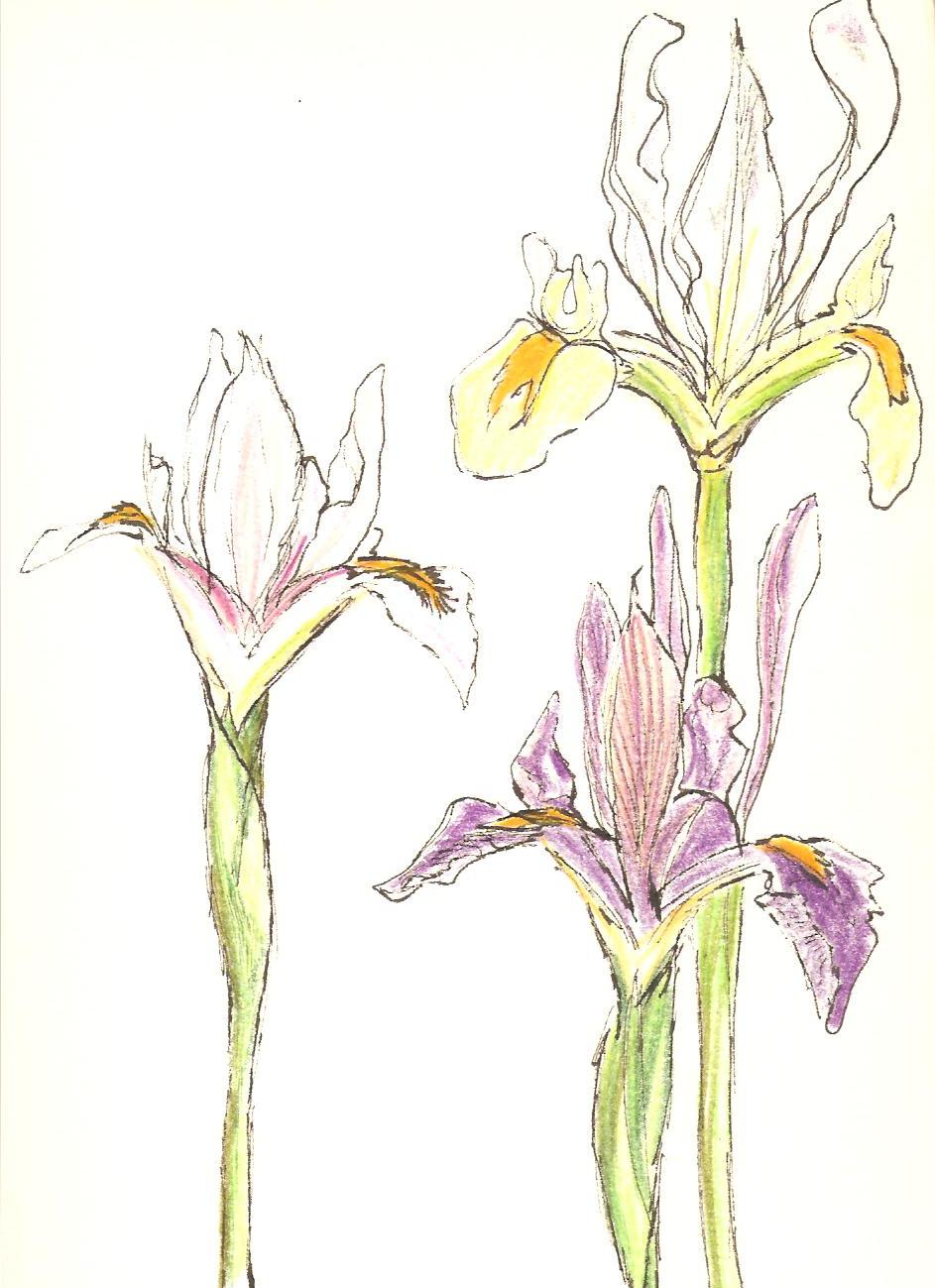
First-year gardener Michel grew some fine irises this year.


A bouquet of Feverfew.

My neighbor Susan's herb garden.

Shannon's colorful creative patch.

Garden Gloves


Jon's Buddha, appropriate for the Garden Guru.


Small apples from a little apple tree Jon planted.


Sunday, June 13, 2010

The New Library

Johannes started noticing something odd when the new library opened. The old square building with its heavy granite layers, gloomy cave-like courtyard and iron-gated entranceway had been expanded and transformed into an open piazza of light and air. The front façade was now almost entirely made of slightly tinted sea-green glass and a café had been arranged under delicate white ceiling lamps that reminded him of astral blossoms. The metamorphosis was stunning, brilliant even. One could sit there and look out over the historic square with its businesses, offices and shops, in the center of which stood a Neoclassical statue of Minerva, goddess of wisdom and war, immortalized in bronze, flanked below by a triad of Civil War soldiers. One could easily imagine sitting inside that glass wall in the rain or the snow, gazing out at the traffic and people outside as one might gaze out from heaven onto the mortal straits below.

But the new odd thing was not something within the library – at least that’s what Johannes thought at first. A subdued, soft-spoken man in his early sixties, he had lived in some of the world’s greatest cities – Berlin, London, Singapore, New York. The only child of a wealthy couple, he had attended private schools. The three of them lived off the income of a successful furrier business. He had traveled extensively with his parents and never felt the rancor or rebelliousness many children in circumstances similar to his had harbored. He loved them deeply and when they grew older he had spared no expense in prolonging their lives, first in retirement communities, then in assistant living facilities. The business had long since been sold, and it cost what remained of their entire fortune to provide them with the best care throughout their extended old ages. Now he lived hand-to-mouth, working as a security guard at a hospital where he earned barely enough to maintain his minimal expenses and the cheap studio apartment he rented over a downtown coffee shop. He was neither bitter nor happy, but was resigned.

One of his greatest pleasures was the library. Its storehouse of books, computers, music, newspapers and magazines – all for free – represented an enormous treasure to him and he had suffered during the time it was temporarily downsized for a year and then closed for over a month during renovations and expansion. It wouldn’t have been an exaggeration to say that as far as he was concerned, if for some unthinkable reason the library had closed for good, it would have meant the end of his existence.

The first time he sat in the luminous glass atrium under the uncanny lamps in that lofty space, he was so overwhelmed he couldn’t focus on the sections of the old New York Times he collected at work, but found himself sipping coffee and simply absorbing the refined atmosphere, watching the people who drifted past like bright fish in an aquarium, letting his mind drift in fabulous directions. The splashing sound of the newly restored Little Water Girl fountain in the entranceway outside was most hypnotic. During his second visit he managed to read a bit more (collected stories of Maupassant this time), but was still so entranced that he found himself drifting into a meditative sense of complete comfort and well-being. The third time he sat in the café, he read more steadily, growing accustomed to his new haven. But this was when he first noticed something odd.

He had been sitting and reading, sipping coffee, gazing occasionally at the dark-red Victorian brick facades across the street. He had strolled past those buildings hundreds of times and had never realized that rows of small, mullioned windows of colored glass glittered in the sun on some of the upper floors. In fact he was quite sure they were new. Yet how could that be? He had never noticed them before. He shrugged it off as one of the many self-deceptive tricks of aging. Perhaps he had just never studied them from this angle. In subsequent visits, however, he noticed other changes across the street – since when had there been a blue awning over the coffee shop, for example? And on the second floor of the public market, which had recently withstood its own renovations, he could clearly see windows crammed with trees and flowers, when he knew for a fact there were only lots of tables up there lined on the interior by a pizzeria and other vendors.

The next day, before he went to the library, he stopped at the market house, mounted the long wooden staircase to the second floor, and found it to be exactly as he had known – an open room with tables, chairs, and stalls with clever names such as Kamasouptra, Peanut Butter Jelly Time, the Pie in the Sky Pizza and Rock City Coffee Roasters. No plants, trees or flowers in sight. Well, perhaps there had been some sort of special event, he reasoned. The city was constantly transfiguring itself in that way.


He was immersed in the tail end of one of the French tales and was feeling rather sleepy, despite the dark roast he was imbibing. When he looked up a sort of carnival in the square had commenced – people dressed in bright festive clothes were strolling about and children – a multitude of children – were playing some sort of game with large green balls and hoops. There was music too – an accordion player and a guitarist and a singer and ladies dressed in fancy dresses were dancing, swinging to and fro, accompanied by men in striped shirts. How completely odd this was. Some sort of Society of Creative Anachronism, he supposed. But it looked positively Parisian – a far cry from medieval jousting or Civil War skirmishes. Excitedly he grabbed his book and went inside to the circulation desk where he approached Babette, the former dancer. “Look,” he gasped breathlessly, “In the square. Over there. What’s going on?”
Babette looked up from her pile of books. She gazed past him and then looked up. “Mr. Kappel,” she said mildly, “That’s nothing but some kind of protest going on. Nothing that unusual. Are you feeling yourself today?” Her look of confusion turned to one of apprehension, and then concern. “Perhaps you’d like to sit down.”
“Oh, no, no, quite all right. I just dozed off for a moment, I’m afraid,” he muttered and staggered off, out the door and onto the sidewalk where he could clearly see that yes, indeed, there was a scraggly mob of people with picket signs, protesting health care reform or the incessant wars or excessive taxation. There were no musicians or costumes or children playing with hoops. He immediately went home, called in sick to his evening shift at the hospital, and lay down in the dark with an ice pack on his forehead. He feared he might be losing his mind.

He didn’t venture back to the library for several days. He took brisk walks, bought expensive salads he couldn’t afford and sat in the coffee shop below his apartment. But everything was as usual, the same buildings, the same sorts of people, everything in its place. No sudden changes or manifestations or hallucinations. Perhaps he had fallen asleep that day. The more he walked and the more spinach he ate, the more he was convinced that was the case.

Still, he felt apprehensive the next time he entered the new archway and walked past the newly restored statue of the young girl with the bare feet, an endless spray of water pouring from a bowl in her hands to the basin below. He returned the Bowles, smiled broadly at the librarians and took his time selecting a book from the special section of books recommended by the library staff – The Emigrants by W.G. Sebald, a novel he had always meant to read. He signed it out, carried it into the bright café, took off his heavy wool coat and gloves and sat down at his table. It was late April and unseasonably chilly outside.


Casually he sat down, crossed his legs and commenced reading about life in England: “At the end of September 1970, shortly before I took up my position in Norwich, I drove out to Hingham with Clara in search of somewhere to live. For some 25 kilometres the road runs amdist fields and hedgerows, beneath spreading oak trees, past a few scattered hamlets, till at length Hingham appears, its asymmetrical gables, church tower and treetops barely rising above the flatland. The market place, broad and lined with silent facades, was deserted, but still it did not take us long to find the house the agents had described.” He pretended to be absorbed in the narrative, though the truth was he filled with trepidation, afraid to look over at the square. Afraid of what? Afraid that things would have changed, or that they might be the same? The second he considered the latter possibility he immediately raised his woolly, silver head.

The changes were vast this time. It was a new city, grown from within the old. The square itself had become a park with tall flowering chestnut trees that looked to be at least 100 years old. And the people – he could see immediately they were European. The bleak old Victorian buildings had given way to lovely, colorful houses painted in blues and greens and yellows with slanting rooftops and window-boxes.

This time Johann didn’t even consider sharing his vision with any of the other patrons or the staff. No, now he was quite content to sit and watch the transmogrification of the past, present and future as it unrolled before his eyes – a miracle of time and space that defied all reason and yet, he realized, made perfect and absolute sense. He turned back and gazed around the cafe. The other patrons, a mixture of young, middle-aged and elderly Portlanders, including two Somalis, and one Cambodian, were all immersed in their own separate journeys through time.

Copyright 2010 by Annie Seikonia.

Sunday, June 06, 2010

The Art of Gardening and Garden Art

The Bayside Community Gardens are flourishing. My garden has garlic, chives, cilantro and onions (from seed!), spearmint, peppermint, foxglove, Sweet Annie, chamomile, hyssop, dill, Siberian Iris, Bat Face flowers, lupine, three apple trees, fennel, oregano, thyme, feverfew, lavender, rosemary, basil, lemonbalm, and a big mystery plant!


Here are some drawings I made of some of the BCG garden plants: